Pilates
Standing Pilates for Beginners Over 40: A Gentle Start
Aug 5, 2026 · 6 min read
If the word Pilates brings to mind a studio full of complicated machines, or getting up and down off the floor repeatedly, this guide is for you. Pilates is really just a method of moving with control, breath and good alignment, and almost all of it can be done standing up. That makes it a lovely place to begin after 40, especially if your knees, wrists or back would rather you stayed off the mat. Here is a simple first routine and the beginner tips that make it stick.
What Pilates actually is
Pilates is a low-impact method built around a handful of ideas: move slowly and deliberately, breathe steadily rather than holding your breath, keep your spine long, and let the deep muscles around your middle do the stabilising. There is no bouncing, no jumping and no rushing.
It suits women 40+ because the effort is in the control, not the load. You are asking your body to move well, not to move hard, which is exactly what helps posture, core support and steadiness on your feet.
Why standing Pilates is a kind place to begin
Classical Pilates has plenty of mat work, but the principles do not need the floor. Standing versions keep every benefit while removing the parts that beginners most often find off-putting.
- No getting up and down, which is easier on knees, wrists and hips.
- No mat, no equipment and no special clothing needed.
- You can do it in the space of a bath towel, in any room.
- It doubles as balance practice, because you are on your feet the whole time.
- A wall or sturdy chair is always within reach if you want light support.
A gentle first routine (about 12 minutes)
Move through these slowly. Quality beats quantity every time in Pilates, so three controlled repetitions are worth more than ten rushed ones. If anything feels sharp, make it smaller or skip it.
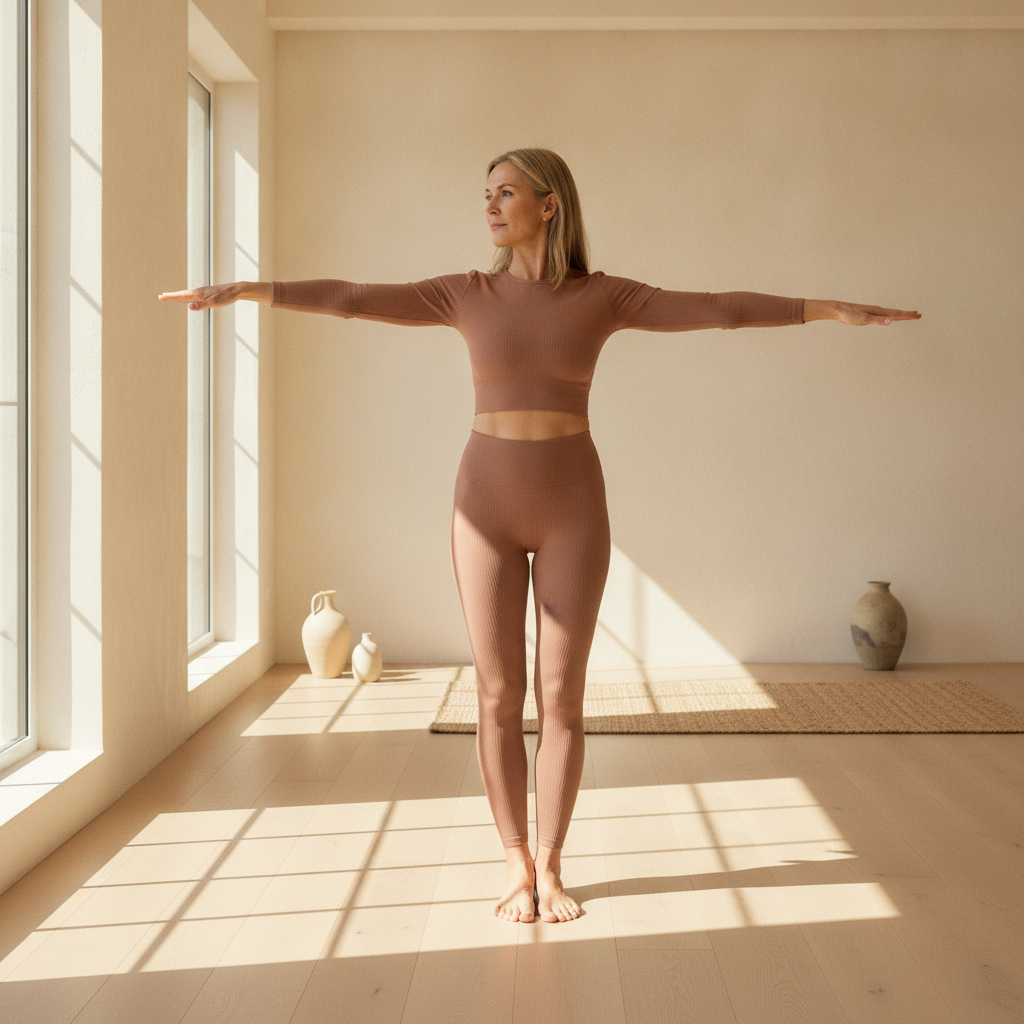
- Find your stance (1 minute): Feet hip-width apart, knees soft, ribs stacked over hips. Breathe wide into your ribs, and let your lower belly gently draw in as you breathe out.
- Roll-down (2 minutes): Nod your chin to your chest and roll down through your spine one bone at a time, letting your arms hang. Pause, then roll back up just as slowly. Repeat three times.
- Arm circles (2 minutes): Float both arms out to the sides and draw slow, small circles, keeping your shoulders down away from your ears.
- Side reach (2 minutes): Reach one arm overhead and lengthen up and over to the side, feeling a long stretch through the waist rather than a crunch. Return through centre and swap.
- Standing knee lift (2 minutes): Draw one knee up towards hip height with control, brace gently through your middle, lower it and swap. Hold a chair if you like.
- Spine twist (2 minutes): Stand tall, arms softly forward, and rotate your upper body to one side keeping your hips facing front. Return through centre and swap.
- Close (1 minute): Stand still, shoulders soft, and take five slow breaths.
Beginner tips that make it stick
The first few weeks are about learning what controlled movement feels like in your own body. That is the whole job.
- Go slower than feels natural. In Pilates, slow is harder and more useful.
- Breathe out on the effort. Never hold your breath to brace.
- Keep your shoulders down and your jaw unclenched.
- Stop each movement at the point where your form would start to break, not past it.
- Two or three sessions a week is plenty to begin with.
- Stop if you feel dizzy, breathless or any sharp pain.
What to expect in the first month
Pilates progress is quiet. You are unlikely to feel wrung out afterwards, and that is by design. What women most often report first is standing a little taller, noticing their posture at the desk, and feeling steadier going down stairs.
Strength around the middle and hips follows over a few weeks. Once the routine feels familiar, you can add a couple of minutes, hold the positions a little longer, or let go of the chair during the knee lifts.
If you have a health condition, are recovering from an injury, or feel unsure, check with your doctor before starting new exercise.
Frequently asked questions
Do I need a mat or any equipment to start Pilates?
No. Every movement in the routine above is done standing, so you need no mat and no equipment. A sturdy chair or a wall nearby is useful if you want light support during the balance moves.
Is Pilates safe if I have knee or back concerns?
Standing Pilates avoids the kneeling and floor transitions that often bother sensitive knees, and the movements are slow and controlled rather than loaded. That said, if you have a specific back or knee condition, speak to your doctor or physiotherapist before starting.
How often should a beginner do Pilates?
Two or three short sessions a week is a good starting point. Consistency matters far more than length, and a focused 10 to 15 minutes done regularly will serve you better than one long session a fortnight.
Will Pilates help me lose weight?
Pilates builds strength, posture and body awareness rather than burning large numbers of calories. It supports steady weight change best as part of a wider routine of gentle daily movement and balanced eating, not as a quick fix.
How long before I notice a difference?
Most women notice posture and body awareness changes within two to three weeks, and strength around the middle and hips over a couple of months of regular practice.
Ready to start gently?
Take the free 2-minute quiz and get a chair-fitness plan built around your body and pace.
Take the quiz